
GNE Model; Group Norm Evolution
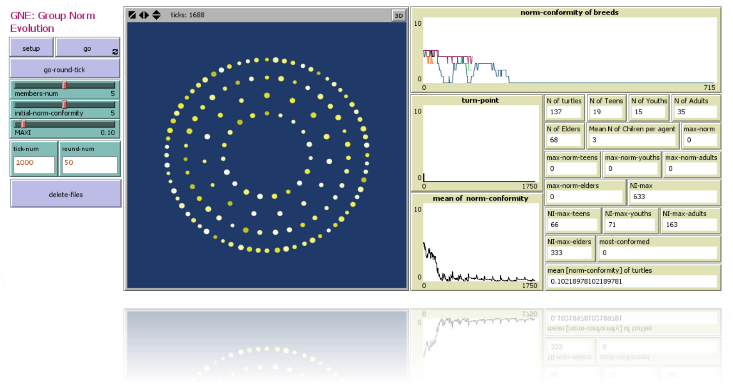
The model is inspired from a basic model by J. M. Epstein and it is based on field ethnographic data about the case.
Model elements:
- Agents represent people in a 16*16 world (n = 65). There are two types of agents: youths and elders. According to the field observations about 80 percent of agents are youths and the rest are elders.
- Norms are two: red-norm and blue-norm. Agents at a time can have one of these two.
- Norm assignment to the agents can be in two types:
- Random: about half of the agents will start with red-norm and the other half start with blue-norm.
- Monolith: at setup step, all agents start with the same norm (blue or red).
- Youths: if in the last three time ticks, a same norm dominate, and it is the agent’s norm, it will become thoughtless.
- Elders: if in the last six time ticks a same norm dominate, and it is the agent’s norm, it will become thoughtless. When an agent becomes thoughtless, its shape updates to a happy face.
- majority-youths: the number of youths with blue-norm minus the number of youths with red-norm.
- majority-elders: the number of elders with blue-norm minus the number of elders with red-norm.
- thoughtless: the number of thoughtless agents at a time.
- red-norm: the number of agents with red-norm.
- blue-norm: the number of agents with blue-norm
- Innovation could be brought into the world by youths or/and elders. This represents external factors influence on the group. In fact, innovation is the probability to change one’s norm at a time randomly. There is a different in the value of youths’ and elders’ innovation.
- Norm change would happen for an agent when a majority of other same type (youths or elders) have the other norm.
- Thoughtlessness means that an agent obeys norm without thinking about others behavior. It happens to agents when:
GNE model is downloadable here : Download
This model has designed by Ahmadreza Asgharpour Masouleh, Seyedeh Zeinab Ghayour and Masoud FattahZadeh


